Why the Energy Transition Needs AI: Insights From a 2025 Comprehensive Review
A 2025 comprehensive review shows why renewables alone cannot ensure stability and how AI improves forecasting, coordination, and system-level efficiency.
ENERGY & INFRASTRUCTUREINDUSTRY & AUTOMATION
E.J. Hofmann
11/10/20253 min read

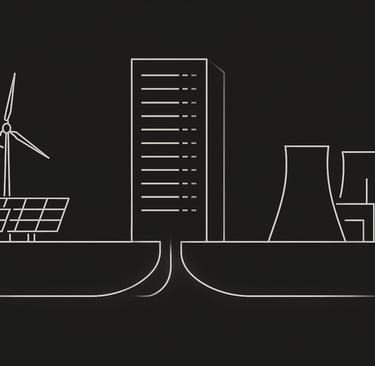
Over the past decade, solar PV, wind turbines, and battery storage have experienced substantial cost declines. Despite these improvements, clean energy systems continue to face reliability and operational challenges. According to Wang, Li and Li (2025), these issues are not primarily technological limitations on the generation side. Instead, the authors report that coordination, variability, and system-level constraints are the core barriers.
The review synthesizes recent research on renewable energy integration, demand-side management, forecasting, and AI-based control. Across the studies surveyed, the authors find that AI methods can provide measurable improvements in efficiency, scheduling, and flexibility. However, they also note that long-term performance depends on data quality, interoperable infrastructure, and consistent operational standards.
Variability in Renewable Generation and System Stability
The review highlights that renewable generation introduces significant temporal and spatial variability, which complicates secure and economic system operation. Insufficient transmission capacity or regional coordination can lead to substantial curtailment. One example cited is China in 2016, where wind curtailment reached 47% in Gansu and 45% in Xinjiang.
Although PV and wind costs have decreased since 2010, these reductions do not automatically ensure efficient utilization. Variability creates constraints that cannot be addressed through capacity expansion alone. The review indicates that accurate forecasting, improved dispatch, and coordinated regional operation are required to manage intermittency effectively.
Rising Demand and the Role of Demand-Side Management
Electricity demand is expected to increase significantly as electrification accelerates. The review references IEA projections showing that global demand could more than double by 2050. In this context, demand-side management (DSM) becomes a key strategy for flexibility.
The authors report that a 1% improvement in demand-side efficiency between 2020 and 2050 could avoid roughly 130 billion USD in clean-power investment. They also summarize evidence that information feedback, social comparison, and incentives produce consistent reductions in energy use. As electrification expands load from mobility, heating, and industry, the capacity to forecast, schedule, and shift demand becomes essential for maintaining reliability.
AI Applications and Their Reported Operational Effects
Across the studies included in the review, AI techniques are found to provide measurable improvements when applied in appropriate conditions:
Buildings: A meta-review of 125 studies shows that AI-based HVAC control improves energy performance, averaging around 31% savings, with some cases reaching 60%
Industry: Integrating AI analytics into SCADA systems resulted in 7.75% energy savings in the cited automotive case (≈177,000 USD annually)
Forecasting: Ensemble methods achieved error rates of roughly 2% rRMSE for solar irradiance and about 5% for wind speed
System flexibility: Automated demand response could unlock up to 185 GW of flexible capacity and avoid around 270 billion USD in infrastructure investment, according to IEA estimates referenced in the review
The authors note that these benefits are dependent on organizational and technical readiness. In fragmented environments, inconsistent inputs, legacy constraints, or insufficient training can significantly reduce effectiveness.
System-Level Constraints: Governance, Data, and Interoperability
The review concludes that long-term success depends on data quality, technology interoperability, and clear operational standards.
Data Governance and Quality
AI performance is highly sensitive to data granularity, structure, and completeness. The review notes that data availability varies widely across regions and technologies, creating uneven foundations for deployment.
Interoperability and Technical Standards
Fragmented standards and limited compatibility between system components restrict scalability. The authors emphasize the need for consistent interfaces, standardized protocols, and unified evaluation frameworks.
Privacy, Cybersecurity, and Regulation
As energy systems become more data-intensive, privacy and cybersecurity considerations become increasingly important. The review indicates that regulatory alignment will be needed to support reliable and secure AI-based control.
Conclusion
The 2025 systematic review shows that while renewable technologies have achieved major cost declines, operational challenges persist due to variability, rising demand, and coordination requirements. Across sectors, AI-based methods demonstrate improvements in forecasting, control, and flexibility when supported by adequate data governance and interoperability.
The authors conclude that effective integration of AI into the energy transition requires coordinated strategies that align technical capabilities with system-level needs. Standardized protocols, transparent validation frameworks, and robust data ecosystems are essential foundations for reliable and efficient clean energy systems.
Source
Wang, Li & Li (2025). Integrating artificial intelligence in energy transition: A comprehensive review. Energy Strategy Reviews. https://www.sciencedirect.com/science/article/pii/S2211467X24003092
© 2025. All rights reserved.
Espen Hofmann
B.Sc. in Human Resource Studies: People Management (Tilburg University)
A personal archive of projects, research, tools, and ideas in progress.
This website is intended for informational purposes only.
The content is based on research, academic sources, and personal analysis.
Nothing here should be considered financial, legal, or investment advice.