Why Great Companies Still Fail: The Innovator’s Dilemma
by Clayton M. Christensen
CORPORATE ENTREPRENEURSHIP
E.J. Hofmann
4/6/20266 min read
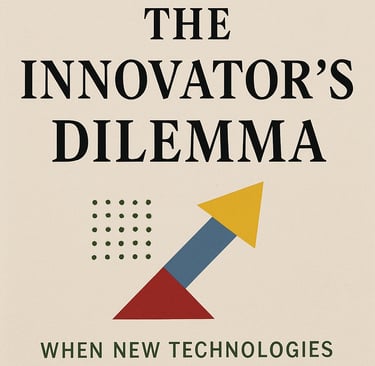
There is something deeply unsettling about Clayton Christensen’s opening argument in The Innovator’s Dilemma: companies do not always fail because they are badly managed. Sometimes they fail because they are managed exactly as they should be.
That is the paradox at the heart of the book’s introduction, and it is what makes Christensen’s thesis so durable. He is not interested in easy explanations like executive incompetence, strategic laziness, or a lack of market intelligence. Instead, he asks a much harder question: what happens when the very practices that make firms successful in stable markets become liabilities in moments of technological change?
The answer, in Christensen’s framing, is that good management is not universally good. It is conditional. What works brilliantly in one environment can become dangerously limiting in another.
The uncomfortable premise
Most companies are taught a familiar set of managerial instincts. Listen to your best customers. Invest in the most profitable opportunities. Improve products in ways the market already values. Allocate resources toward areas with visible demand and attractive margins.
On the surface, this is not just reasonable advice. It is the foundation of modern management.
Christensen’s introduction complicates that logic. He argues that these practices help firms win in the world of sustaining innovation, where improvements align with what current customers already want. But they become much less reliable when innovation is disruptive.
This is where the book becomes interesting. Christensen is not simply saying that managers should be more imaginative or more risk-tolerant. He is saying that disruption often looks irrational at the beginning. It appears small, low-margin, and underpowered. It does not appeal to a company’s most important customers. It does not fit neatly into the economic logic of the incumbent business. And because of that, strong firms often reject it for reasons that make perfect sense at the time.
That is the dilemma. Rational decisions, taken one by one, can produce strategic failure in aggregate.
Sustaining versus disruptive innovation
The introduction sets up the conceptual distinction that drives the rest of the book: sustaining technologies versus disruptive technologies.
Sustaining innovations improve performance along dimensions mainstream customers already care about. They make existing products better, faster, stronger, more reliable, or more profitable. Established firms tend to excel here because their systems, incentives, and customer relationships are all built to support these kinds of improvements.
Disruptive innovations operate differently. At first, they often underperform on traditional metrics. They may seem cheaper, simpler, less polished, or relevant only to fringe users. Incumbents look at them and see weak demand, low returns, and technical inferiority.
But that first impression is precisely what makes them dangerous.
Disruption does not win by beating incumbents at their own game on day one. It wins by entering where incumbents are least motivated to compete, then improving over time until it becomes good enough for the mainstream market. By then, the established firms may realize the shift is real, but their capabilities, priorities, and revenue expectations are already tied to the old model.
Christensen’s point is not that firms are blind. It is that they are often structurally disincentivized from seeing weak signals as strategically important.
When customer focus becomes a trap
One of the sharpest insights in the introduction is the idea that listening to customers can backfire.
This sounds almost heretical because customer-centricity is usually treated as a universal virtue. Christensen does not reject it outright, but he shows its limits. If firms focus only on their current best customers, they tend to move steadily upmarket, adding more features, more performance, and higher prices. In doing so, they may end up overserving the market.
That is where disruption enters.
A simpler product that initially looks inferior may actually be good enough for overlooked users, cost-sensitive buyers, or new customers who were never served at all. Incumbents ignore these segments because they are small or unattractive. Yet those segments can become footholds. Over time, the new entrant improves, moves upward, and starts competing for the mainstream.
What looked like a low-end distraction becomes the basis of a new competitive order.
This is one of Christensen’s most enduring contributions: the idea that market leadership can produce a kind of strategic tunnel vision. The better a firm becomes at serving its existing customers, the easier it becomes to miss the next market entirely.
The real problem is not stupidity. It is incentives.
The introduction is especially persuasive because it avoids the lazy morality tale. Christensen does not present disruption as a punishment for arrogance alone. He presents it as an outcome of organizational logic.
Large firms have processes for allocating capital. They have profit expectations. They have sales teams focused on major accounts. They have investors who reward predictable returns. They have managers who are promoted for hitting targets in existing markets, not for chasing tiny, uncertain opportunities.
Under those conditions, disruptive innovations are hard to justify internally. They start too small. Their customers are not attractive enough. Their margins are too low. Their trajectories are too uncertain.
In other words, established companies do not usually reject disruptive technologies because they misunderstand spreadsheets. They reject them because the spreadsheets reflect the economics of the current business.
This is what makes Christensen’s argument powerful. He turns disruption from a story about individual failure into a story about system design. The problem is not just mindset. It is the relationship between organizational success and organizational rigidity.
The deeper lesson
The deepest value of the introduction is not the terminology. It is the inversion.
We are used to thinking that success comes from doing proven things better. Christensen suggests that success can also create blind spots. A firm becomes so effective at serving today’s market that it loses the ability to invest seriously in tomorrow’s.
That is why the book begins with a dilemma rather than a formula. There is no neat managerial commandment here. The challenge is not simply to innovate more. It is to recognize when the logic of the current business is no longer enough.
That requires leaders to question some of their strongest instincts. It may mean taking small markets seriously. It may mean funding lower-margin experiments. It may mean backing products your best customers do not yet want. It may even mean creating structures outside the core business so that disruptive ideas are not crushed by the expectations of the existing one.
Those are uncomfortable moves. But that is exactly Christensen’s point. The future rarely arrives in a form that established success is designed to welcome.
Final thought
The introduction to The Innovator’s Dilemma endures because it names a pattern that feels counterintuitive but rings true: organizations often fail not in spite of their strengths, but because of them.
That insight still matters. In business, in technology, and arguably in institutions more broadly, the danger is not always inertia in the obvious sense. Sometimes the deeper danger is disciplined commitment to a model that once worked extraordinarily well.
Christensen’s opening argument is a warning, but it is also a lens. Once you see it, you start noticing the same question everywhere: what are we doing well today that may be preventing us from seeing what matters tomorrow?
Comprehensive Q&A:
What is the 'Innovator's Dilemma' exactly?
Well-managed firms often fail not because they are badly run, but because they do the “right” things for their current business. They listen to their best customers, invest where margins are highest, and improve existing products. That logic helps them win the present. But it can also cause them to ignore a new kind of technology that at first looks worse, smaller, and less profitable. By the time that technology improves enough to matter, a new entrant may already own the market. If the firm keeps focusing on its current customers and current profit logic, it risks missing the future. If it invests early in the new technology, it may hurt its current business and spend resources on something that looks unattractive today.
How is the disruptive vs. sustaining distinction different from the radical vs. incremental distinction?
Radical vs. incremental describes how big the technological change is. A radical innovation represents a major technical advance; an incremental innovation is a smaller improvement to what already exists.
Disruptive vs. sustaining describes how the innovation affects the market and customers, not how technically dramatic it is. A sustaining innovation helps established firms serve their existing customers better. A disruptive innovation typically begins by serving overlooked, low-end, or new customers with a simpler, cheaper, or more convenient solution, and only later moves upmarket.
So the key point is: radical/incremental is about degree of technological novelty, while disruptive/sustaining is about market impact and competitive dynamics. Because of that, the categories do not line up automatically: an innovation can be radical but sustaining, or incremental but disruptive.
Why do firms not invest in disruptive technologies?
Their best customers do not want them at first.
The markets look too small.
Margins are worse.
Existing resource-allocation processes filter them out.
Budgets and investment decisions are usually based on current customers, current competitors, and current return expectations. That systematically favors sustaining innovations.
The firm’s capabilities are tied to the current business model.
Investing too early can seem irrational internally.
Paradox: Firms fail because they are behaving rationally according to the metrics and incentives of their current success.
© 2025. All rights reserved.
Espen Hofmann
B.Sc. in Human Resource Studies: People Management (Tilburg University)
Research & Insights on Artificial Intelligence, Human Capital & the Future of Work
This website is intended for informational purposes only.
The content is based on research, academic sources, and personal analysis.
Nothing here should be considered financial, legal, or investment advice.
Impressum
Datenschutz