The Slow Trap of Corporate Success
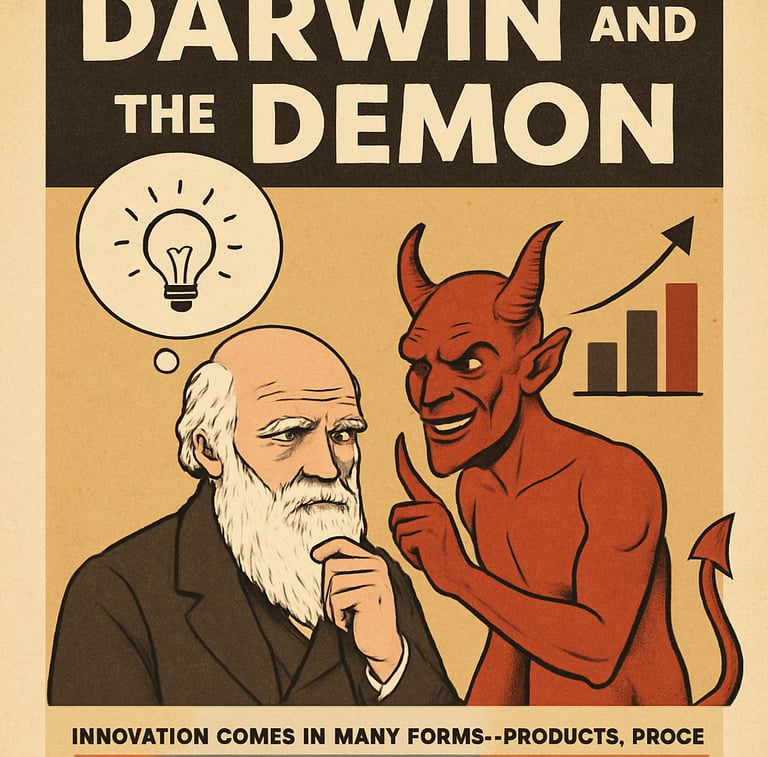
This is a short reflection on Geoffrey A. Moore’s Darwin and the Demon: Innovating Within Established Enterprises, focusing on its central argument about innovation, market life cycles, and the internal inertia that makes established firms struggle to change.
CORPORATE ENTREPRENEURSHIP
E.J. Hofmann
4/19/20264 min read
Reflection
Moore’s article is interesting because it refuses the lazy version of innovation talk. He is not saying that companies simply need to “be more innovative,” as if innovation were one generic virtue. His point is sharper than that. Different kinds of innovation matter at different points in a market’s life cycle, and firms get into trouble when they keep relying on the type of innovation that made them successful in an earlier phase. That is the core insight of the piece: the real problem is not just failure to innovate, but failure to change the mode of innovation when the market changes.
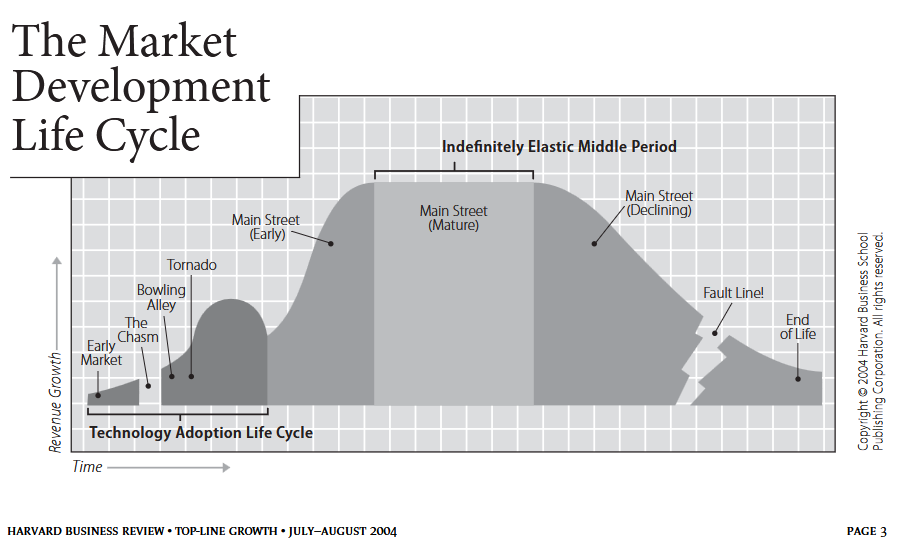
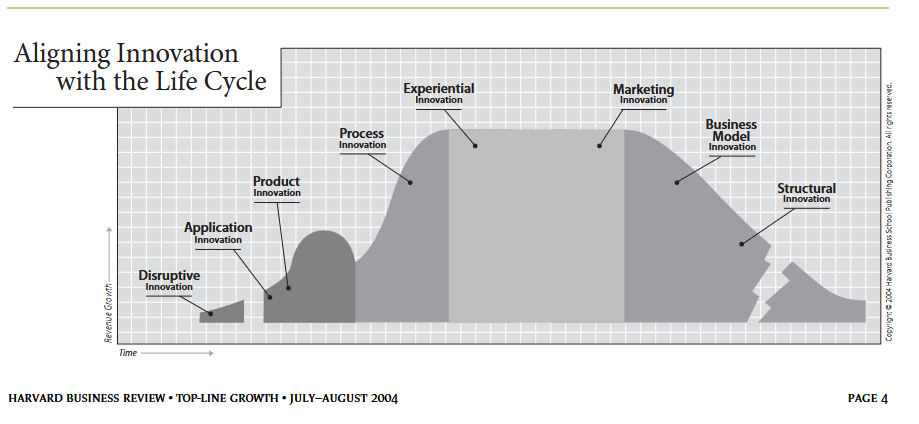
What makes the article especially useful is the taxonomy it builds. Moore distinguishes disruptive, application, product, process, experiential, marketing, business model, and structural innovation. That alone is a helpful corrective, because it broadens the concept of innovation beyond breakthrough products. But the article’s real contribution is linking those forms to the market development life cycle. In the early phases, product-oriented forms of innovation dominate. Later, once markets mature and commoditization sets in, process, experiential, and marketing innovation become more valuable. And when decline approaches, the serious question is no longer how to improve the existing offer, but whether the firm can reinvent its business model or structure before the fault line opens beneath it. The chart on page 4 makes this especially clear by mapping innovation types onto the life cycle itself.
The most compelling part of the article, though, is not the taxonomy. It is the “demon” in the title: inertia. Moore argues that success itself creates resistance to change. A firm becomes good at one set of capabilities, organizes around them, rewards them, and begins to treat them as normal. Then, when the environment shifts, those same strengths become anchors. That feels like the article’s most persuasive argument because it explains why strategic change is so difficult even when leaders can see the need for it. Organizations do not just have competencies; they have habits, loyalties, structures, and sunk investments. In that sense, inertia is not accidental. It is institutionalized success.
Moore is also very practical about what this means. He argues that firms cannot just build the new and hope the old fades away on its own. They have to pursue what he calls a parallel process of construction and deconstruction. That is an important move. Innovation is usually framed as addition—new products, new teams, new ideas. Moore insists that it also requires subtraction: centralizing, standardizing, simplifying, automating, or outsourcing legacy processes that no longer create differentiation. On pages 5 and 6, that argument becomes almost brutal in its clarity. The point is not to preserve old structures out of sentiment. It is to free resources for the next source of advantage.
What the article leaves me thinking about is whether firms usually fail from external disruption or from internal attachment. Moore seems to suggest the latter is often deeper. Markets evolve, yes, but the fatal delay comes from the organization’s inability to stop treating yesterday’s strengths as permanent assets. That is what gives the article its force. The danger is not only that the world changes. It is that successful firms become too well-shaped by the world they already know.
Source: Moore, “Darwin and the Demon,” Harvard Business Review, July-August 2004, p. 86-93
Q&A
1. Explain the title of this article.
The title “Darwin and the Demon” brings together the article’s two main forces. “Darwin” refers to market evolution: industries change over time, markets mature, commoditize, decline, and eventually get replaced. Firms have to adapt to that shifting environment or they lose their advantage. The article’s life-cycle model is really a map of that Darwinian pressure.
The “demon,” by contrast, is internal. It is the inertia that builds up inside successful firms. Moore’s point is that companies do not just face external competition; they also face their own habits, structures, and legacy capabilities. The article argues that success creates routines and commitments that make change harder later on. So the title captures the real tension of the piece: firms are pressured from the outside to evolve, but held back from the inside by inertia.
2. Which type of innovation should firms focus on?
Moore’s answer is that there is no single best type of innovation for all firms at all times. The right kind depends on where the firm is in the market development life cycle. In early stages, firms should focus more on disruptive, application, and product innovation, because those are the forms that help create and shape new categories. Once the market matures, those forms lose leverage, and process, experiential, and marketing innovation become more important. Later still, when the category is declining or nearing a fault line, business model and structural innovation matter most because the firm may need to reinvent itself rather than simply improve what already exists.
So the article’s real point is that firms should focus on the kind of innovation that matches their market’s stage of development. The mistake is not failing to innovate altogether; it is sticking with yesterday’s innovation logic when the market has already moved on.
3. How can inertia be overcome?
Moore argues that inertia cannot be overcome just by adding something new and hoping the old system gradually fades away. That is one of the article’s clearest points. Instead, firms need a twofold strategy of construction and deconstruction. On one side, they must build new innovation capabilities with the right leadership and sponsorship. On the other, they must actively dismantle legacy processes and structures that are absorbing resources without creating real differentiation.
He is very concrete about how this should happen. Legacy work should be centralized, standardized, simplified, and then automated or outsourced where possible. The logic is blunt: if an old activity no longer drives customer preference, it should not keep consuming scarce resources. At the same time, those resources need to be redirected toward the next source of competitive advantage. In that sense, inertia is overcome not by inspiration alone, but by deliberate organizational reallocation. Firms have to build the future while stripping down the past.
© 2025. All rights reserved.
Espen Hofmann
B.Sc. in Human Resource Studies: People Management (Tilburg University)
A personal archive of projects, research, tools, and ideas in progress.
This website is intended for informational purposes only.
The content is based on research, academic sources, and personal analysis.
Nothing here should be considered financial, legal, or investment advice.